

The THREE FIELDS translocal collaborative project has made space for a year of conversations shared between Kaajal Modi, Deepa S. Reddy, and Samukelisiwe Dube, located in the UK, India, and South Africa respectively.
Conscious of the many ways in which movements of plants, people, and food—forced and desired, engineered and organic, industrial and personal—have made modern food systems as they are, these conversations have naturally gravitated towards “food migration” as a key, overarching thematic. A first way to track these movements is through common, elemental ingredients: salt, pepper, cinnamon.
In the narrative below, Deepa reflects on how the project’s themes gathered in stories of pepper, an ingredient so globally common it is almost completely disassociated from its cultural and botanical contexts of origin. What does it mean to listen to pepper for the pasts it carries but cannot speak? Five tala patra or toddy palm leaf paper panels facilitate this experiment in listening. Visitors are invited to pick up each panel, feel the leaves and the etchings, read and engage with the object in its own right before placing their chosen panel down on a designated spot to activate a binaural soundscape. Three panels are etched and illustrated with poems from the Tevaram (by Thirugnana Campantar, 7th century); two with verses from texts in the Ettuthokai (“The Eight Anthologies,” 100-200 BCE) of the Sangam period.
Each one makes reference to pepper. Deepa’s work in this prototype phase thus reassembles fragments of what we think of as “the past,” asking how it might be made available and accessible as a sustaining resource for the present. Her work seeks restoration that is both cultural and ecological, social and botanical; it returns us sensorily to the places, past and present, where pepper vines continue to grow.
Listen to sound snips from the chaptered soundscapes narrated by Deepa and creatively engineered by Mrityunjay Sathyanarayanan of Ayahi Atelier here:
How will I tell you? - Listen! - Seed of the World - Mulligatawny
COMMON BLACK PEPPER
Thinking my way backwards from Kaajal’s workshops at Kirkgate Market, “UK food culture in microcosm,” I find myself in what we could call one of those source geographies, still made by European demand and lure. The scales and balances have shifted drastically, and with them any clarity about what precisely is moving or how–but from here food, fragrance, taste, spice still goes to all their many elsewheres.
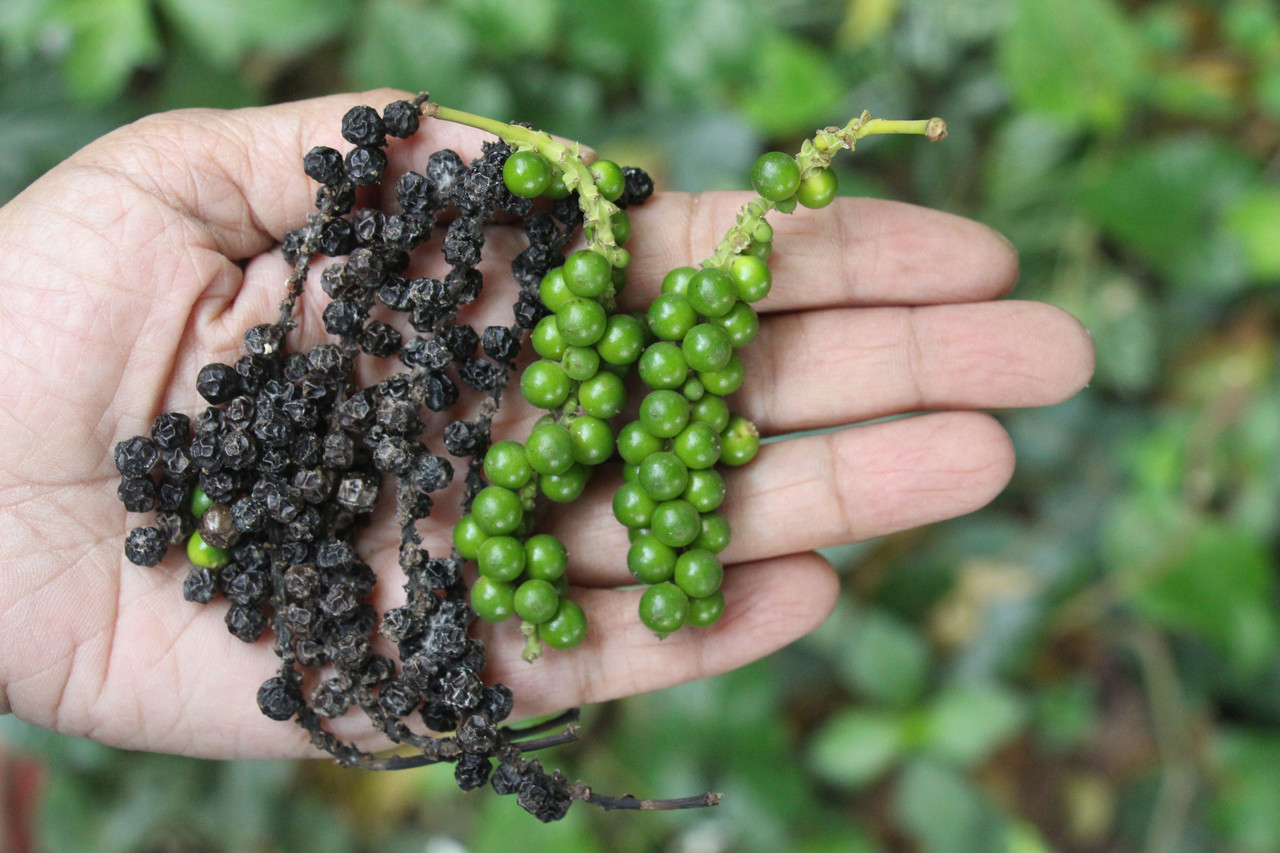
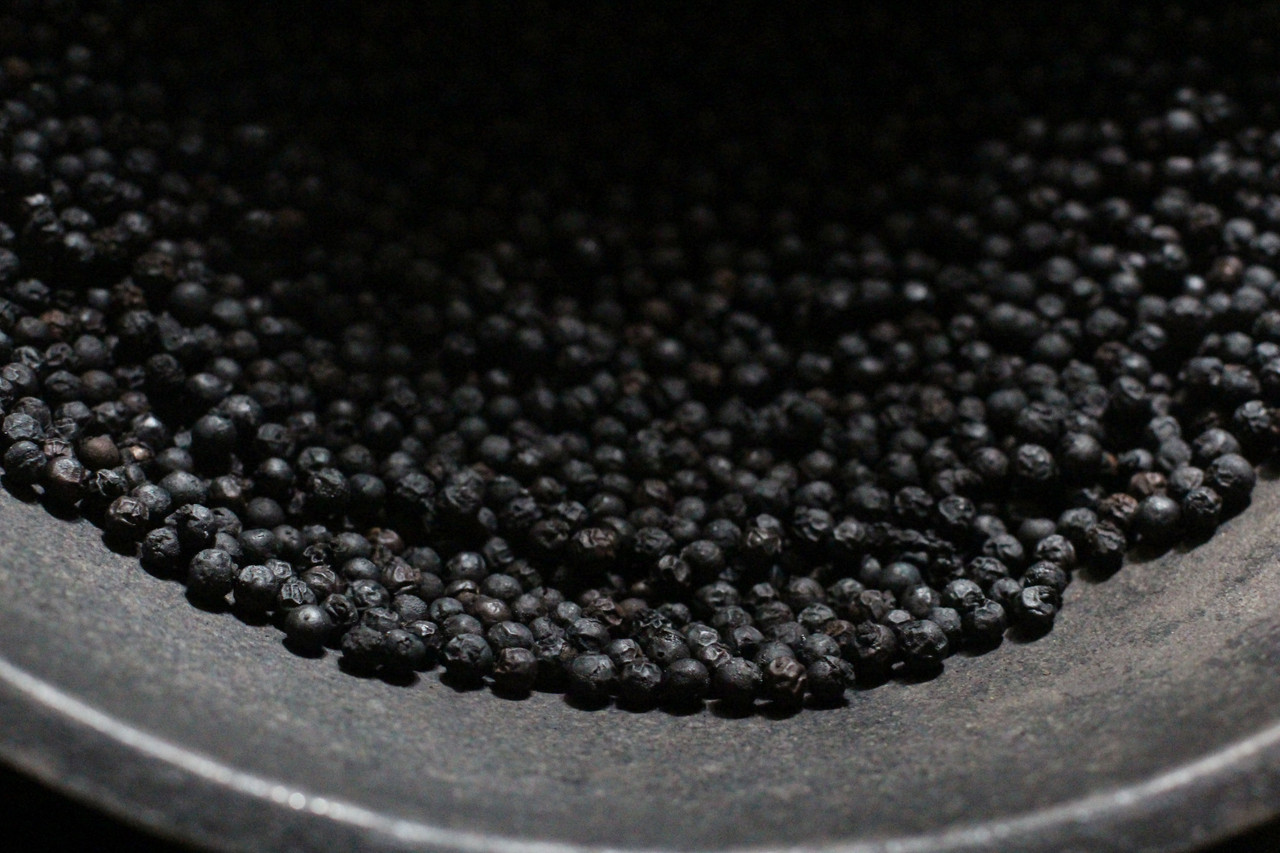
Here is a landscape made first by pepper, which was there at the beginning, our “once upon a time” tiny, crinkled black dot of origin. For all we know of the pepper trade that once shaped life on the Malabar coast, we no longer think of it as special - any more than we think of cotton as special, or indigo, or rice. Commerce made pepper common, available, cheap, ubiquitous; going elsewhere plucked from its vegetal origins to the point that we, neither here nor there, would recognize the pinhead yellow-white of a pepper flower or understand that the fruit turns orange and then red before it becomes black–a seed slowly burning and charring like the kaṟi/கறி the Tamils always said it was. Instead, commonness overrides. Salt and pepper on every table, freer than drinking water. Cracked black pepper at the end of every recipe like an afterthought of taste, originating from a convenient little pepper mill whose elegance matches the table on which it sits, filled by supermarkets or perhaps refilled from packets bought at a sneeze-inducing Indian grocery, but certainly not from a tangled vine that grows up a coral tree so ramrod straight and tall, you can barely reach the ripening strands with a ladder.
No wonder then, that we have forgotten entirely the imaginarium that pepper once was. That swift turn of the pepper mill that cracks the corns cracks memory and lineage, too.
REMAKING THE SOIL
Like Samu and Kaajal, I have been concerned in this project with place and placemaking, how places are made by the movement of people, things, plants, the rushing water and the blowing wind, each one an agent of pedogenesis, or soil formation. After all, movement produces new ground, claiming it, re-claiming it, edging in so other things are edged out, demanding new things of the earth, breaking the ground and re-making it so that people, things, plants can grow from it again. But never in the same ways.
Beneath and betwixt the migratory threads that became our focus in the THREE FIELDS project, however, are things that never really move. The pepper plant is one such, never moving far out of its native growing ranges, not like the Ceiba trees whose pods packed with seeds and white hydrophobic silk-cotton floated East, impossibly, at some or many prehistoric moments to pepper our landscapes, leaving their Mayan cosmologies behind but picking up associations with our own Bombax, the red semal or shimul. Not like tamarind, which also arrived with ancient movements, and became the one souring taste to rule them all while remaining always on the edges–roadsides, pond-sides, so the ghosts living in its branches can come out every night to play. But very much like chillies, which arrived from the Americas and which were hot like Malabar pepper was pungent but “discovered” second, so they took its name: Tamil thippili, to Sanskrit pippali to Greek peperi to Latin piper to Old English pipor to Middle English peper to modern pepper.
Thippili was of course long pepper, Piper Longum, chilli-like in how it pops up and forms, likewise containing incomparable pungency. Piper Nigrum, black pepper, was pepper first by comparison, named by all these swirling commercial movements, Roman partialities, Plinian pronouncements, changing European tastes. It all happened such that nobody really paid attention to how its old Tamil name kaṟi/கறி travelled to become the Anglicized “curry”: the hot, the pungent, the burning, the blackening, the spiced. Pepper has always been just here like that, an old native signifier, differentiated commercially into Kerala Tellicherry or Cambodian Kampot by soil or ripening time or processing care but otherwise differentiated by cultivars, of which there are over 75 in India alone.
FINDING FRAGMENTS
But what is this here? I got to thinking. What is the place that pepper made?
That place is this place, mine, under my feet, in the forests that edge my garden, accessible but also lost, everywhere but in disassociated fragments, pushed to the peripheries by urbanization and “development,” both here and no-more-here than Atlantis, to be resurrected from scattered literary works and historical records, language and anecdotes and the traces that modern practices carry with them still.
I have to gather the pieces, I started to think. But how? And from where all?
Then Lodi Matsetela (with Fak’ugesi in South Africa at the time) asked, on one of our group calls with partners, whether artworks have to live forever, whether they necessarily have to be more than ephemeral. The thought of only creating something tentative at first gave me relief. It was daunting to think of creating anything that resembled permanence.
But then the fragments interjected. The toddy palm, that other native witness dotting the dry landscapes of Tamil Nadu the way pepper dots the green hills, pushed into my view poems invoking pepper inscribed on its leaves, 400 years old. We have those fragments because they lasted. We can listen for lost worldviews because the palmyrah leaves, processed into writing paper, did not disintegrate, and because people cared for olai chuvadi or palm leaf manuscript bundles enough to allow the voices and words of those who wrote poems on them to travel down to us, like pepper on rain-fed rivers rushing down from the hills.
What else do we have that lasts so long these days? Plastic, nuclear waste, polystyrene, toxicities. Not that permanence, I thought, increasingly aware of the toddy palm’s prickly, stately counter to the merely ephemeral, its own quest for eternity. It’s not only things which don’t bio-degrade that last forever. Eternity is neither inert nor obdurate or toxic, but a richly living, sustaining thing.
LISTENING FOR THE PLACE THAT PEPPER MADE
And so it was that I came to pepper via the literary world of the toddy palm tree, where indeed it had been all along, waiting to be found and heard. Samu wants to make seed paper that we can see germinating. I want paper to seed ideas that push like roots into the soil of our own physical and imaginative pasts, and to find in them the moral, aesthetic, material sustaining elemental resources by which to remake the present. Kaajal wants to listen to the soil, literally. I live in a world made by metaphor and likeness, the comparison of chillies to thippili, the comparison of rivers tossing plants to Kings throwing charities, or foaming water like churning butter. I want to listen to the soil, too, but in this way, figuratively.
Listening first means unraveling; it’s not just another auditory activity, but conscious acts of seeking. Finding the forest, or bringing it into the garden. Standing at the foot of the trees on which pepper grows, asking to see, asking to hear. Being there at the right moments, or risk missing the flowering and having to wait another season, or missing the arrival of the hornets who build the tidiest little home amidst the vines and are naturally fierce meeting intruders.
Touch the paper which is the leaf. Feel its smoothness, feel the etchings the poet’s stylus carved, the repeating, rounded forms that hint at rhyme and rhythm. Allow the textures to ferry you to treetops and hilltops from which you can see pepper vines climbing, or being washed down in the torrential rains. Do you hear the waterfalls roar?
For the poets are equally concerned with placemaking. They speak not in abstract generalities, but of particular localities: of the Kollidam which is the Kaveri’s northern-most distributary cutting through Sirkazhi; of the semi-perennial Vaiyai (Vaigai) which falls from the sky, of the Kaviri’s (Cauvery) force at Kurangaduthurai, of the Siva of Tiruvetkalam. In these place-marking poems, there are relationships, there are tastes, there is sensation, there are gestures, there is promise, there is vitality, there are rains, there are floods–and all these things in specific combinations like recipes in all the places that pepper makes.
I’d like to think of my work as restorative, reconnecting all these dots. We’ve spoken about accessibility so often in the Three Fields project, and how soundscapes are one solution to providing low carbon footprint access to an experience across far-flung terrains - but I want my work also to make the past accessible, an available, living resource of associations, imageries, and seeds. Access is not a swinging door that’s either open or closed. We get there I think not just by looking, but by listening for the subsonic sound filaments that are audible only in the interstices of observation.
Don’t move. Listen to the stories with your whole self. Become alive to the sounds of the soil beneath your feet. Like the pepper vine really, climbing, dropping, lifting, pulling from the soil all that is poured into it.
Deepa and THREE FIELDS will be part of EyeMyth in New Delhi, 21-22nd February 2026. Find out more.