

THREE FIELDS was an international digital arts collaboration launched in 2025 bringing together artists, cultural organisations, and creative technologists across India, South Africa, and the UK to explore environmentally conscious creative digital practices.
Three artists based across these territories came together to explore our relationship with food systems, whilst engaging with each other and their work in environmentally sustainable ways.
With the support and facilitation of Fast Familiar, the artists met regularly online, sharing their practice and delving into their own respective localities while nurturing reciprocity and connection across different contexts. Geographic distance was negotiated through experiments in embodiment: cooking rice together, describing spaces and gestures sensorially, talking about the weather, all became part of a collaborative endeavour evolving at the pace of each artist.
Each artist developed their work with a chosen spice/ingredient at the core of their research: salt for Kaajal Modi, pepper for Deepa Reddy and cinnamon for Samu Dube. Stories of migration, preservation, exchange and distribution unfolded, connected by the use of binaural sound, an immersive technology capable of providing an embodied, resonant experience in the listener, without the environmental impact of other VR/AR technologies. Parts of this evolving artwork came together to be exhibited at EyeMyth Media Arts Festival, Delhi in February 2026.
These prototype artworks do not present themselves as a cohesive, singular artwork. They offer fragments of an ongoing body of practices led by a promise of justice and sustainability, and insights into the artists’ collaborative process – online, by market stalls, in gardens and kitchens across India, South Africa and the UK. At its core, THREE FIELDS wanted to support a process-led collaboration, prioritising experimentation, learning and reflection over a final artwork. Ambitions to embed environmental sustainability and access considerations were carried over not only in the subject matter of the work, but in our methods, technologies, and rhythms of collaboration itself.
Explore the artistic offerings below, introduced by our THREE FIELDS artists.
Pepper, Deepa Reddy (India)
The soundscapes for “Pepper” were conceptualised by Deepa Reddy and creatively engineered by Mrityunjay Satyanarayanan of Āyāhi Atelier.
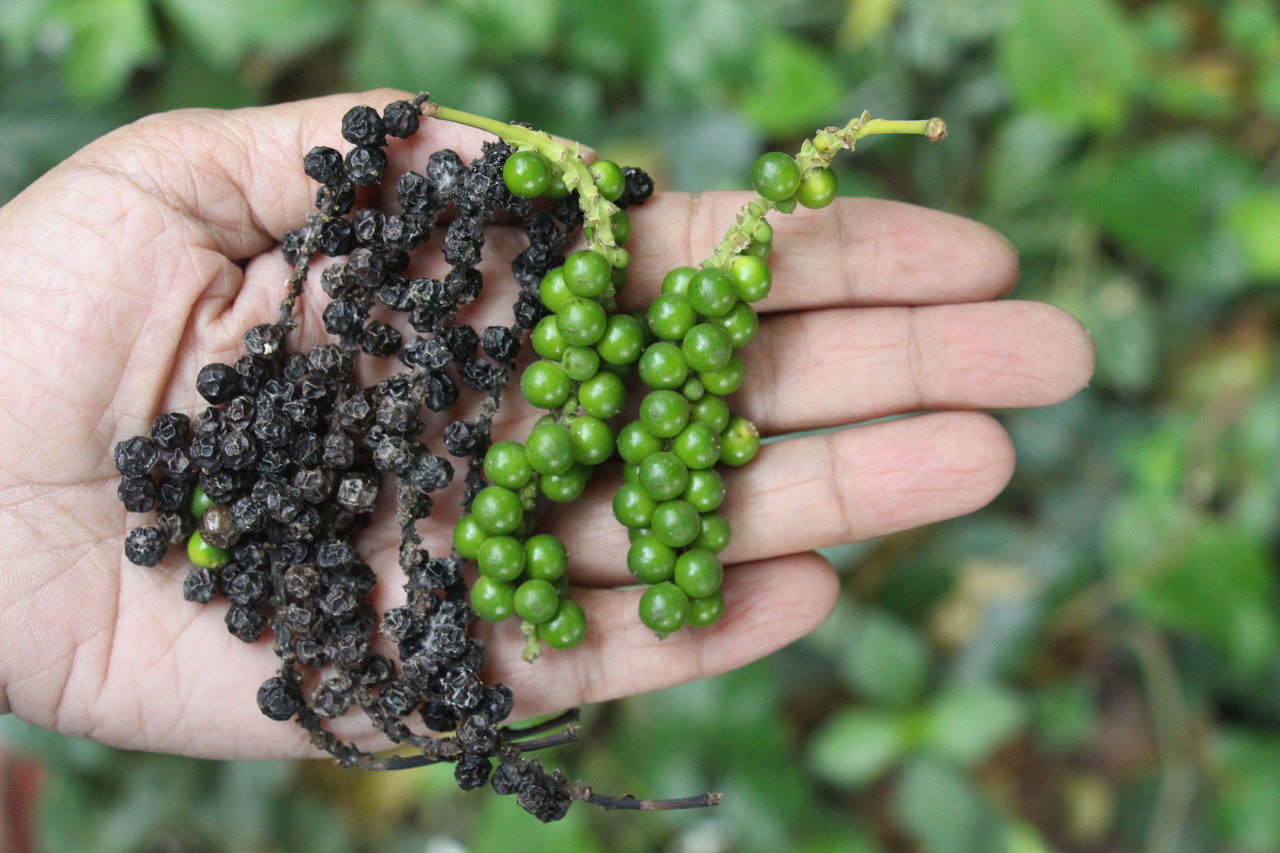
The process we followed was circular: a script directed the recording of a series of sounds, which called for a revised narration, introducing new sonic themes and dimensions. And round from there. The idea was not to speak in any single voice, but to invoke an Indian pati, a grandmother whose depth and range of historical witnessing and didactic self-assuredness come only with age, long culinary experience, and being set firmly within particular Indian cultural worlds. Every Indian will intuitively imagine her as an old village crone with skin black and crinkly like pepper seeds, and will recognize her as a peculiar source of authority who is never mentioned in published papers or other attested sources because there, it is as though she doesn’t exist. The soundscapes seek to restore her voice and its insights to a rightfully central place in the long, complex, world-changing, and little-understood story of pepper.
The approach is inspired by works like Raja Rao’s Kanthapura–in which a grandmother narrates, in her own particular dialect with her own unique style of expression, the story of how Gandhi’s struggle for Independence came to a typical village in South India: a notable innovation for Indian writing in English in 1963. “The telling has not been easy,” Raja Rao wrote of this work, “One has to convey in a language that is not one’s own the spirit that is one’s own. One has to convey the various shades and omissions of a certain thought-movement that looks maltreated in an alien language.”
Likewise, the pepper soundscape is inherently and instinctively bilingual, in dialect, accented English, implied finger-wagging gestures and more. Layered in is a recipe, untranslated, barked almost in a series of un-proportioned and un-explained ingredient-names which native cooks will know to handle to prepare rasam, the original “mulligatawny” or molagu-thanni: pepper water. Layered in are also sounds from markets where merchants sell pepper and spices and tell us about making rasam from packet masalas which are readily available these days. Layered in is the earthy crunch of the red soil of the garden, the pancha-bhoota or 5 elements which are conjured in the cooking process: earth, water, fire, air and ether. You can hear them; perhaps you can expect to taste them, too. Layered in are songs from Sangam poems and the Tevaram–a collection of 7th century “hymns,” each of which make reference to a literary and religio-cultural landscape which was once defined predominantly by pepper.
Hear the poems and the poets singing, hear the pati, hear the cooking, hear the challenges and the ripostes; feel the water, the sea-breeze blowing, the fire lighting and burning, all in the world which pepper made and burned black, like its own crinkly hard self. Listen to:
How will I tell you? - Listen! - Seed of the World - Mulligatawny
Salt, Kaajal Modi (UK)
Of time and salty tides
The interactive narrative, Salt, offers a way of reflecting on and sharing some of the conversations we had been having as artists over the duration of the THREE FIELDS collaboration. It also holds the stories that I have been gathering from the community, within the soundscapes, in their own words and voices, through the residency at Kirkgate market. They are the voices of the people I gathered, and the foods and ingredients I was fermenting as inks and dyes in the space, over time, using salt.
Twine is often used to create interactive narratives based on decision-making that guide the player through different experiences based on their choices, in a choose-your-own adventure style text-based game. I wanted to push back against this style of individual ‘heroic’ storytelling, offering instead a more situated polyphony that rewards attentiveness to the everyday and mundane, and that is not quite so straightforward to navigate. These issues are complex, and require attention. This story, and the narrative mechanisms of the story, reward that attention.
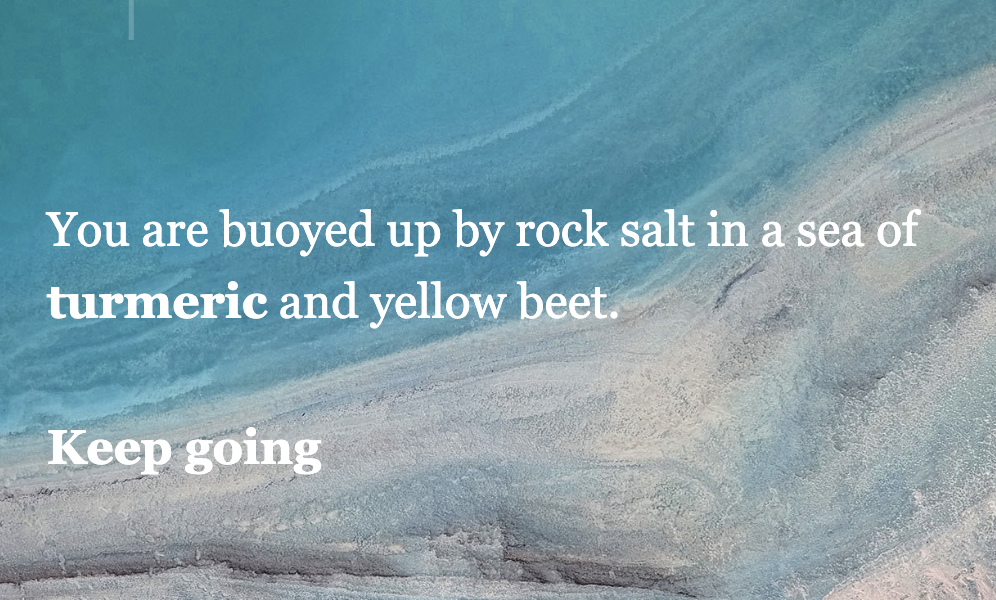
Salt, like the stories it holds and the soundscapes created from these, has the capacity to build and loop. If played straight, choosing your adventure by clicking on the explicit (usually binary) choices at the bottom, you reach the end very quickly. If, however, you stay attentive, and consider the words you are being offered beyond their initial meanings, other routes are opened up. These routes quickly become closed loops, unless you continue to stay with the trouble you are revealing through the choices you make.
This project is about the journeys we take over time and tide, the tears we shed over the things we leave behind, and opportunities to imagine differently. You are offered a route well-travelled, but you are also offered opportunities to reveal what is hidden in the most mundane ingredients you might encounter in your kitchen and in your landscape. These hidden encounters layer, and offer spaces for your own experiences, until (I hope that) what is revealed is your own story in relation to those you have been reading about, and listening to.
Cinnamon, Samukelisiwe Siphesihle Dube (South Africa)
This soundscape is an invitation to listen, not only with the ears, but with memory, with the body, and with the land.
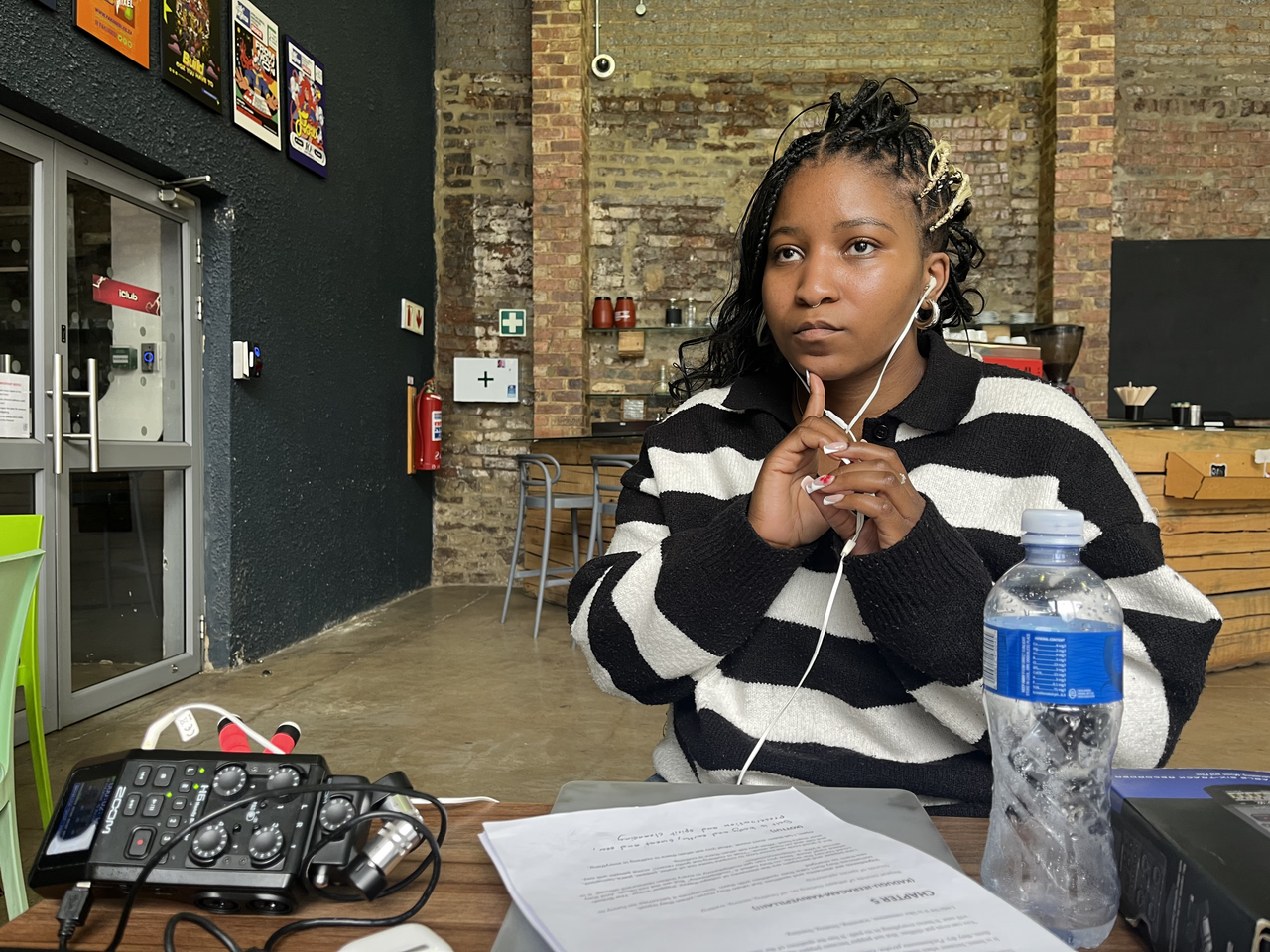
Created in collaboration with my supervisor, Thebogo, and brought together through sound by Ayahi, this binaural piece weaves together poetry, breath, and the material language of cinnamon, in its bark, seed, and powdered form. Alongside this, you will hear the quiet presence of nature: birds calling, trees moving, water flowing, and air passing through the body.
These sounds are not separate.
They exist in relation, just as food exists in relation to land, to history, and to migration.
Cinnamon, as the central material, becomes both subject and guide. Its journey across continents, from its origins to our kitchens, carries stories of trade, displacement, healing, and adaptation. In this work, its textures are made audible, cracked, ground, dissolved, revealing the intimate and often unseen life of a single spice.
The use of binaural sound allows for a closeness that mirrors the intimacy of cooking, of listening, of remembering. As you move through the piece, sounds shift around you, near, far, behind, within, inviting you to inhabit a shared sensory space that stretches across territories.
This is not just a composition.
It is a gathering of elements.
A conversation between soil, spice, and spirit.
We invite you to listen slowly.
To notice what surfaces.
To consider what travels through food, through sound, through memory, and what remains.
THREE FIELDS is an international co-commission between Abandon Normal Devices, Arts Catalyst, Fak’ugesi, Fast Familiar and Unbox. Funded by the British Council’s International Collaboration Grants and supported using public funding by Arts Council England.